Link to online paper: https://doi.org/10.1525/elementa.2025.00052
Abstract
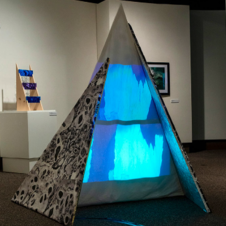
Ocean memory embraces the idea that the ocean retains, processes, and expresses information across a range of timescales, from moments to millennia. The Ocean Memory Project brings together scientists, artists, and scholars to investigate this notion from a transdisciplinary perspective, integrating empirical research with creative expression. Here, our scientific and artistic efforts center on the Lost City hydrothermal field, an otherworldly site on the deep Atlantic seafloor that offers rare insights into early Earth processes and the potential for life beyond our planet. In 2018, we sailed to Lost City and carried out our joint microbiological, geochemical, and artistic efforts. Our sampling revealed that the ultramafic rocks that underlie the field undergo reactions that support complex ecosystems dependent on interspecies cooperation to overcome extreme chemical limitations. These same rocks serve as a geologic sink for organic carbon carried with circulating seawater, a process likely active for as long as hydrothermal circulation has existed on Earth. These discoveries highlight the complex, evolving nature of subseafloor ecosystems and exemplify the ocean’s capacity for memory. Alongside the science, the expedition supported an artist in residence, Anna Davidson, who created a body of work inspired by her time at sea. Her paintings, videos, photos, and mixed media sculptures, some incorporating physical samples and imagery from the dive footage, are not only aesthetic and conceptual reflections of Lost City but also educational resources. By integrating science and art, we argue in this paper for a broader epistemological framework in environmental research—one that recognizes the ocean not only as a site of data but as a dynamic, living archive of memories. Through interdisciplinary inquiry, we can deepen our understanding of the ocean and build more meaningful cultural narratives around its protection in the face of current mounting threats, including climate change and deep-sea mining.